 | |||||
Lute
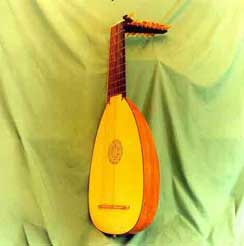
The oud was introduced into Europe by the Moors during their occupation and conquest of Spain ( around 711). The history of the oud is ancient, going back far beyond written history that currently exists. Through the crusades and trade, the oud was spread throughout Europe, and it was adopted as an instrument by the Europeans. Frets were added and eventually the strings were doubled. It became known as the Lute. By 1200, you can see paintings and sculptures of Europeans playing the lute, and by 1400 the players had adopted a standard tuning. The Lute is built with only with wood and glue, there are no nails or screws used in construction. It is the First Instrument for which we find a large quantity of written music. It was a very respected musical instrument of it's time, and probably the most popular string instrument of the renaissance. There was more music written for the lute than any other instrument in the renaissance. In the 14th Century a stable tuning and design appear. It was smaller than the lute pictured here. It had 4 sets of strings, and played with a plectrum. One method of tuning was to tighten the first string until just before it breaks. At first the lute was played with a plectrum, as was the oud. As the music became more complex, the lute was played with the fingers. The construction and the strings are very light. Much lighter than the guitar. Tablature was the early music notation used by the lute and many other instruments of the renaissance. There were many different type: English, French, Italian, Spanish and German. French used letters to show the player where to put the fingers on the instrument, Italian used numbers. 16th and 17th Century was the golden age of the lute. A tremendous amount of music was composed and published. Professional lutenists were in demand by those that could afford it and musicians were well paid. During the Renaissance the lute occupied a special place that was only superseded by the human voice. It was the most popular instrument of it's time, and its repertoire was enormous. |
|||||